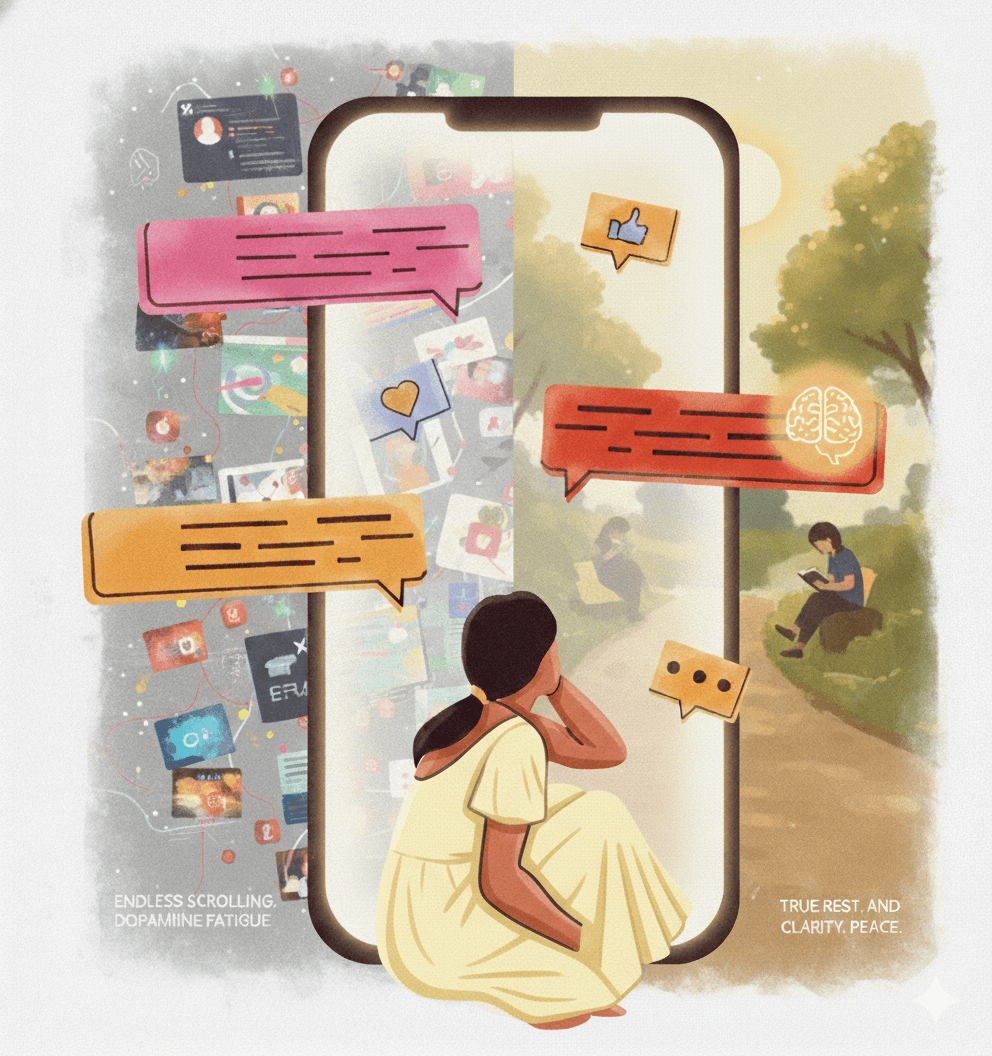
When Being “Online” All the Time Starts Costing You Peace & Clarity
You open your phone to check one notification. Thirty minutes later, you’re still scrolling.
Your eyes feel heavy. Your mind feels loud. And somehow, you’re more tired than before you picked up the device.
You didn’t do anything “wrong.” You weren’t wasting time on purpose. You were just… online.
If this sounds familiar, welcome.
You’re not addicted. You’re not weak. You’re not lacking self-control. You’re simply living in a world designed to keep your attention hooked without teaching you how to protect it.
That is where digital well-being comes in.
What Digital Well-Being Actually Means (And What It Doesn’t)
Let’s clear one thing up first.
Digital well-being is not:
- Quitting social media entirely.
- Throwing your phone away.
- Becoming disconnected from reality.
- Practicing extreme, rigid discipline.
Digital well-being is:
- Using technology without letting it use you.
- Staying informed without becoming overwhelmed.
- Being online without abandoning your nervous system.
Just like burnout is a warning rather than laziness, digital exhaustion is a signal rather than a lack of willpower. It is your brain asking for space.
Why Social Media Feels So Draining (It’s Not Just You)
If scrolling leaves you overstimulated, anxious, or oddly empty, there is a biological reason for it.
- Your Brain Was Not Built for Infinite Input Social media offers a relentless stream of endless content, rapid emotional shifts, and constant novelty. Because of this, your nervous system never gets the time it needs to process. It remains in a state of constant alertness. That is not healthy stimulation: it is pure overload.
- Dopamine Fatigue Is Real Likes, reels, and notifications each provide a small dopamine hit. The problem is that too many hits lead to reduced sensitivity. Eventually, you scroll more and enjoy it less. This is why you might feel restless after scrolling, or why nothing seems to hold your attention for long. Even “fun” content starts to feel exhausting because your brain is simply over-saturated.
- Comparison Happens Quietly Even when you logically know that social media is not real life, your brain continues to compare. Whether it is careers, bodies, relationships, or even “healing journeys,” your self-worth takes micro-hits in the background. You might not consciously feel jealous, but your subconscious is still keeping score.
- We Confuse Consumption with Rest Scrolling feels like rest because you are not physically doing anything. However, your brain is working harder than you realize. It is processing images, regulating emotions, and reacting to constant updates. That is not restoration: that is cognitive labor in disguise.
Signs Your Digital Life Is Affecting Your Well-Being
You don’t need to hit rock bottom to start paying attention. Often, the signals are much quieter. These gentle signs include:
- Feeling foggy after a long session of scrolling.
- Reflexively reaching for your phone the moment you feel bored or slightly uncomfortable.
- Struggling to focus on slow-paced tasks, such as reading a book or sitting in silence.
- Feeling emotionally heavy or drained for no clear, identifiable reason.
- Being tired but wired: feeling physically exhausted yet unable to quiet your mind.
None of this means something is wrong with you. It simply means your mind is asking for quieter inputs.
The Science of the “Scroll”: Why Your Brain Feels Heavy
If you’ve ever wondered why thirty minutes of scrolling leaves you more tired than thirty minutes of working, the answer isn’t a lack of discipline. It’s a direct physiological response to how modern platforms interact with your nervous system.
Here is what is happening behind the screen, according to the latest research:
- The Dopamine Loop (Why You Can’t Stop): Social media functions like a “digital slot machine.” Research shows that frequent engagement with these platforms alters the brain’s reward processing. Each notification triggers a dopamine surge, but over time, your brain reduces its sensitivity to protect itself from the noise. This is called downregulation.
- The Finding: You end up needing more scrolling to feel the same level of satisfaction, making real-life rewards feel dull by comparison.
- Source: Social Media Algorithms and Neurophysiological Impact (PMC, 2025)
- Cognitive Overload (The “Brain Rot” Fog): Your brain has a limited capacity for processing new information. Jumping from a tragic news story to a comedy sketch in three seconds flat creates Cognitive Overload. This prevents your brain from moving information into long-term memory, leading to that “foggy” feeling often called “Brain Rot.”
- The Finding: High screen time is linked to decreased focus and a literal “thinning” of the mental resources we use for impulse control.
- Source: Demystifying Brain Rot in the Digital Era (PMC, 2025)
- The Passive Use Trap (Consumption vs. Connection): Scientists distinguish between Active Use (messaging a friend) and Passive Use (scrolling the feed). Studies show that passive consumption is the primary driver of digital anxiety because it lacks the “belonging” benefits of interaction but keeps all the “comparison” costs.
- The Finding: Moving from passive scrolling to active engagement can significantly reduce the “emotional tax” of being online.
- Source: Active vs. Passive Social Media Use (Information Matters, 2025)
- Upward Social Comparison (The Silent Hit to Self-Worth): Even if you know a photo is edited, your brain’s “comparison engine” still runs in the background. Research confirms that frequent exposure to idealized lives leads to “micro-hits” to our self-esteem, making us feel behind in life even when we are doing perfectly fine.
- The Finding: Social media doesn’t just show us others’ lives; it forces a constant, subconscious ranking that drains our confidence.
- Source: Social Comparison and Self-Esteem (Journal of Psychology of Popular Media)
- The Need for Digital Autonomy: The most recent studies suggest that digital well-being isn’t about how much time you spend online, but how much agency you have over that time. When we feel forced to check our phones by habit rather than choice, our mental health declines.
- The Finding: Users who practice “Digital Autonomy”—making conscious choices about when to log on and off—report significantly higher life satisfaction.
- Source: Digital and Psychological Well-Being (MDPI, 2025)
Practical Solutions: How to Rebuild Digital Well-Being (Without Quitting the Internet)
This isn’t about control.
It’s about designing your digital life with care.
- Create Low-Stimulation Zones: In Your Day Start with small boundaries to help your nervous system reset:
- No phone for 20 to 30 minutes after waking up.
- No scrolling during meals.
- One tech-free pocket of time before sleep.
- Shift from Mindless Scrolling to Intentional Checking: Before opening an app, ask yourself: “Why am I opening this?”
- If you need to reply to someone, reply and then exit.
- If you need to check an update, check it and then close the app.
- If you need to relax, choose something truly restorative instead.
- Replace Dopamine with Depth (Just a Little): Your brain doesn’t need less pleasure, it needs slower pleasure. Depth heals what speed drains. Try swapping:
- High-speed reels for intentional reading.
- Late-night scrolling for music and dim lights.
- Constant background noise for intentional silence.
- Curate Your Feed: Like Mental Hygiene This isn’t avoidance, it’s self-preservation. It is okay to:
- Unfollow content that triggers comparison.
- Mute constant negativity.
- Reduce your exposure to emotionally charged updates.
- Redesign Notifications for Your Nervous System: Urgency is often manufactured. Try to protect your peace by:
- Turning off all non-essential alerts.
- Keeping work apps off your personal phone if possible.
- Using “Do Not Disturb” modes guilt-free.
- Practice Sitting with Boredom: Boredom is not empty, it is fertile ground. Next time you reach for your phone, pause for 60 seconds and let the discomfort pass. This is where:
- Natural creativity returns.
- Scattered thoughts begin to settle.
- Emotional regulation improves.
- Redefine What Rest Actually Looks Like:
Scrolling is passive, but rest is restorative. True nervous system recovery includes:
- Daydreaming without a screen.
- Walking without headphones.
- Gentle movement or stretching.
- Doing nothing on purpose.
A Personal Note: From 12-Hour Shifts to Midnight Loops
There was a time when I believed being constantly available, both online and offline, was simply the necessary tax of a modern career. As a software developer, my days were already saturated with 10 to 12 hours of intense screen time. By the time I finally closed my laptop, my brain wasn’t just tired: it was vibrating with logic, syntax, and looming deadlines.
I told myself I was scrolling to wind down. I convinced myself that those reels and threads were calming my nerves or giving my brain a well-deserved reward after a high-pressure day. But “just five more minutes” inevitably spiraled into two or three hours of lost sleep. I was getting home late, my lifestyle was fracturing, and the very habit I used to destress was actually keeping my nervous system in a state of high alert.
I eventually realized I was doomscrolling, not because the content was valuable, but because I was starving for a sense of relief that a glass screen could never provide. The shift only happened when I stopped looking for rest in a digital void and started reclaiming it in the physical world.
Replacing the Scroll with the Stride: I traded the midnight feed for a simple post-dinner walk. I found that moving my body did more to regulate my nervous system than a thousand viral videos ever could.
The Hard Cut-Off: I began implementing a complete digital blackout the moment my work day ended. No quick notification checks and no staying updated. I had to accept a humbling truth: the world would keep spinning even if I was not there to witness it in real-time.
Relinquishing the Hero Complex: I stopped trying to be the always-available problem solver. I started trusting and depending on my family, friends, and teammates. Asking for help and stepping back from situations where my presence was not strictly necessary changed everything.
Once I stopped seeking validation through a constant digital presence, the change was physical. The chronic headaches faded. That tired but wired feeling vanished. I did not just get my schedule back: I got my clarity back. I did not disconnect from life. I finally reconnected with it.
Gentle Reminders (Read This Slowly)
You don’t need a perfect digital routine.
You don’t need to quit social media.
You don’t need to get it right every day.
Some days you’ll scroll more.
Some days you’ll notice sooner.
Some days you’ll log off early.
Progress isn’t dramatic.
It’s subtle.
And sustainable.
Final Thought
Digital well-being isn’t a rejection of the modern world: it is a reclamation of your own mind. It is the moment you realize that while the internet is infinite, your time, your energy, and your peace are not.
We have been conditioned to believe that staying “connected” is a requirement for success. But the truth is simpler: your mind was not built for the weight of endless consumption. You were not designed to carry the noise, the comparisons, and the crises of the entire world in your pocket 24/7.
Reclaiming your clarity is not a sign of weakness. It is not an act of “quitting.” It is a masterclass in boundaries.
You are allowed to be unreachable. You are allowed to be “outdated” on a trending topic. You are allowed to choose the quiet of a walk over the chaos of a feed.
Staying connected to the world should never come at the cost of losing your connection to yourself.
Reclaiming your peace isn’t anti-tech: it is pro-human.
And doing it gently? That is where your true power lies.
References
Dopamine & Reward Sensitivity: Lembke, A. (2024). Dopamine Nation: Finding Balance in the Age of Indulgence. Research on “Downregulation” and algorithmic reward processing via the National Center for Biotechnology Information (NCBI).
Cognitive Overload & Focus: Anderson, J. L., et al. (2025). Demystifying Brain Rot: Cognitive Load and the Impact of Rapid-Context Switching. Published in Information Matters.
Passive vs. Active Consumption: Kross, E., et al. (2024). The Emotional Tax of Passive Scrolling vs. Active Connection. Journal of Experimental Psychology.
Social Comparison & Self-Esteem: Upward Social Comparison in Curated Digital Environments. Journal of Psychology of Popular Media (2024).
Digital Autonomy: Khalid, M. S., et al. (2025). Digital Autonomy and Psychological Well-Being: Agency as a Predictor of Life Satisfaction. MDPI Digital Health.
- Image credit: Freepik